Identifying Edible Plants and Berries in the Wild: A Scout Safety Guide
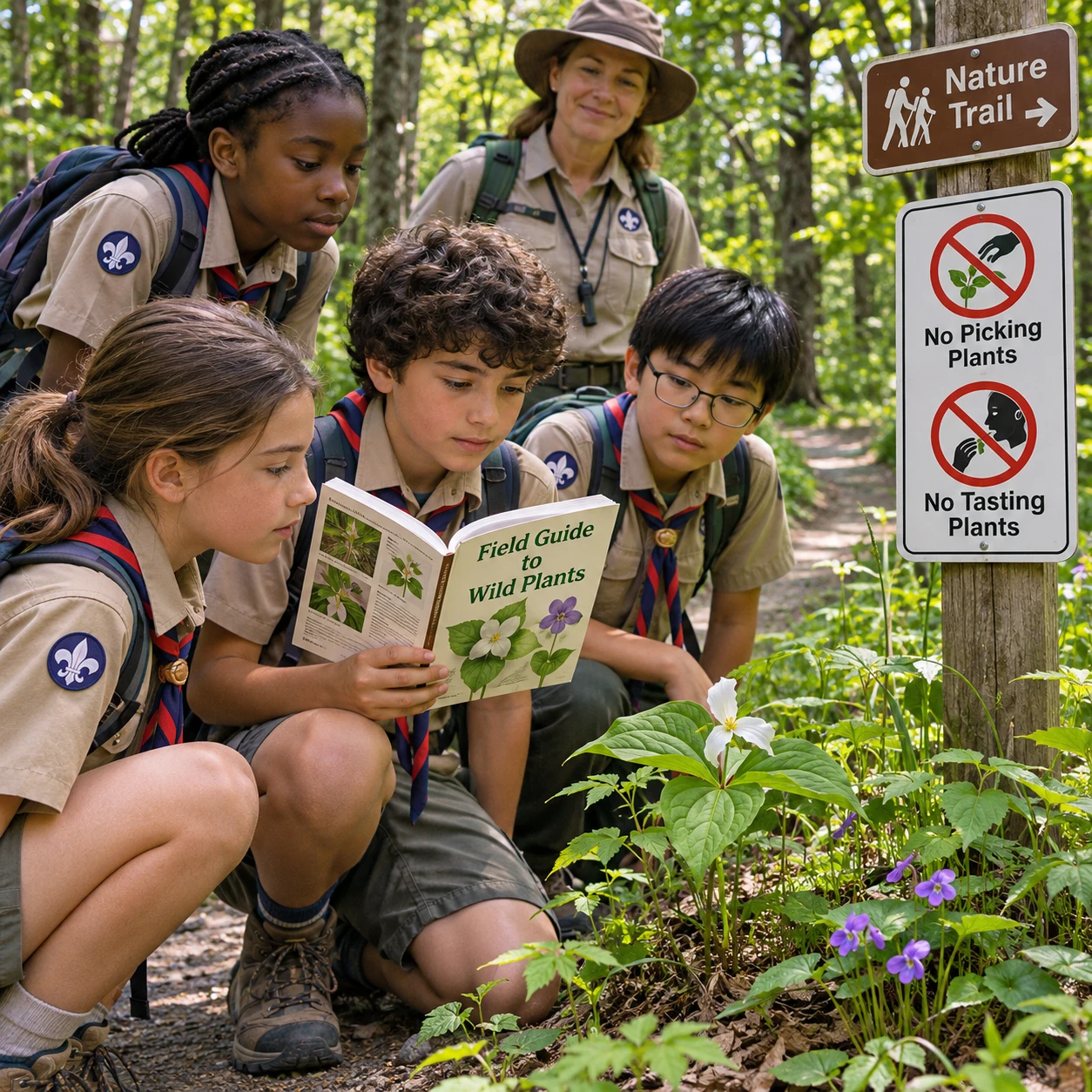
Wild berries and plants can make a hike more interesting, but identifying them is a safety skill, not a guessing game. For a scout troop, the safest approach is to observe plants without eating them and to involve a responsible adult whenever identification comes up.
Color, smell, or a familiar-looking leaf cannot prove that a plant is safe to eat. Use multiple clues and reliable local references, follow your leader’s instructions, and leave any uncertain plant untouched.
Start with safety, not tasting
Never eat a wild plant or berry unless it has been identified with certainty and your scout leader or another qualified adult has explicitly approved it. Appearance alone is not enough, and some poisonous plants resemble edible species.
Even a correct identification may not settle every safety question. The plant could be contaminated by roadside chemicals, animal waste, pesticides, or other pollutants. Local rules may also protect plants or prohibit collecting them. For scouts, the default should be simple: look, record, and leave it where it grows.
Set this rule before the group reaches a patch of fruit or an interesting plant. No sampling to see how something tastes, no nibbling to test a claim, and no collecting for later identification. Children should tell a leader if they find a plant they want to discuss rather than handling or eating it.
Plant identification can be a rewarding outdoor lesson, but eating is a separate decision with higher stakes. A troop activity should focus on careful observation, not foraging.
What to observe when identifying a plant
Plant identification is more reliable when you compare several features together, including leaf shape and arrangement, stems, flowers or fruit, habitat, and season. A single clue, such as a berry’s color, cannot confirm that a plant is edible.
Start by looking at the whole plant without breaking or pulling it. Note whether the leaves are simple or divided, their edges and shape, and whether they grow opposite each other or alternate along the stem. Record details such as stem texture, growth form, and the way leaves attach. If flowers or fruit are present, observe their form and arrangement from a safe distance.
Then consider habitat and season. A plant’s location, elevation, soil, and time of year can help distinguish it from look-alikes, but these clues are supporting evidence, not proof. A plant seen in a forest clearing may be confused with a similar species found in a different habitat; distribution can also vary within a region.
A useful field note includes the date, general location, habitat, plant height, leaf arrangement, and any flowers or fruit. Take several photographs from different angles if permitted. Do not handle a plant that may irritate skin, and wash hands after outdoor study.
Identification is a process of matching the full set of features against a trusted reference. If an important feature is missing, such as flowers or fruit, the right conclusion may be “not identified.” That is a sound observation, not a failure.
How to use field guides and trusted help
Use a field guide written for your region, compare multiple plant features, and ask a knowledgeable adult to review the identification. A photograph or app can help narrow possibilities, but neither should be treated as final proof of edibility.
Choose a current, region-specific field guide that includes clear descriptions of leaves, flowers, fruit, habitat, and poisonous look-alikes. Check that its range covers the area where your troop is hiking. A general guide may not include local species, and common names can refer to different plants in different places.
When using a guide, compare the plant with the full description rather than matching one picture. Check whether the season and habitat fit, and look for stated differences from similar species. If the guide’s details do not match, stop and ask a leader or local botanist, naturalist, park educator, or extension service for help.
Digital identification tools can be useful for generating possibilities, especially when a clear photo includes leaves and the whole plant. They can still misidentify a species, particularly when the image is blurry, the plant is young, or flowers and fruit are absent. Treat the result as a lead to verify, never as permission to eat.
For poison-related advice in the United States, the Poison Control website provides guidance and contact information. Other countries have their own poison information services; identify the correct local resource before an outing.
Beware of poisonous look-alikes
Poisonous look-alikes make guessing unsafe, even when a plant resembles a familiar berry or food. Folk tests, taste tests, and one-feature identifications cannot reliably establish that a wild plant is edible.
Some harmless and harmful species share features such as fruit color, leaf shape, or growth habit. Those similarities can mislead even a careful observer, especially when a plant is young or lacks flowers. A plant’s edible part may also differ from its toxic parts, and preparation does not make every species safe.
Avoid common shortcuts such as “birds eat it, so people can,” “a red berry is safe,” or “a tiny taste will tell.” Animals may tolerate plants that are dangerous to humans. Color does not reveal toxicity, and tasting can expose someone before the plant is correctly identified.
When a feature is uncertain, do not fill the gap with a guess. Do not rely on online comments, an unfamiliar name, or a secondhand story as confirmation. The safest decision for a scout troop is to leave the plant alone and continue the lesson with observation or a verified reference image.
Plan a safe troop identification activity
A safe troop identification activity teaches scouts to observe, compare, and record plants without picking or eating them. Leaders should set clear boundaries, choose an appropriate route, and supervise the group throughout the activity.
Before setting out, explain that no one may taste, collect, or handle plants without direct adult instruction. Check park rules and trail conditions, and remind scouts to stay on the path where required. A short observation checklist helps keep the activity focused:
- Record the date, general location, and habitat.
- Observe leaf shape and arrangement, stem, flowers, and fruit without touching.
- Photograph the whole plant and close views, if allowed.
- Compare observations with a region-specific field guide and note what remains uncertain.
- Share findings with the leader before moving on.
Leaders can make the exercise collaborative: assign small groups to describe different features, then compare notes. The goal is to explain why a plant might match a reference and what evidence is still missing. This rewards careful reasoning rather than confidence alone.
Follow Leave No Trace principles: leave plants where they grow, avoid trampling surrounding vegetation, and take only photographs and notes. This protects habitat and respects local regulations. If identification remains uncertain, record it as unknown rather than trying to settle the question by picking it.
If someone eats an unknown plant or berry
If someone eats an unidentified plant or berry, tell an adult immediately and contact local poison control or emergency services for instructions. Do not wait for symptoms, and do not try home remedies or make the person vomit unless a medical professional tells you to.
Move the person away from the plant and alert the scout leader. If it is safe, keep a photo or sample of the plant for identification, but do not delay seeking help to collect one. Note when it was eaten and, if known, how much. Save any remaining fruit or plant material without tasting it.
Call emergency services right away if the person has severe symptoms, trouble breathing, collapses, has a seizure, or becomes difficult to wake. For other exposures, contact the local poison-control service promptly and follow its directions. In the United States, Poison Control can be reached at 1-800-222-1222; elsewhere, use the local poison information number or emergency service.
Do not wait to see whether symptoms develop. Some harmful exposures may not cause immediate signs, and early professional guidance can help determine what to do next. Keep the group together while the leader manages the response and ensures the affected person gets appropriate care.
Frequently asked questions
Can scouts identify wild plants from photos alone?
Photos can help scouts compare features, but they are not enough to confirm that a plant is edible. Images may omit important details such as leaf arrangement, stem features, habitat, or seasonal changes. Use photos as a learning aid alongside a regional field guide and knowledgeable adult supervision.
Is it safe to taste a small amount to test a plant?
No. Taste-testing is unsafe because a small amount can still cause harm, and taste does not reliably identify a plant. Scouts should never test a wild plant by eating it.
What should we do if someone eats an unknown berry?
Tell a leader or another adult immediately and contact poison control or emergency services for instructions. Do not wait for symptoms or use a home remedy. Keep a photo or sample if it can be obtained safely without delaying the call.
Can we pick plants during a troop hike?
Only if the land’s rules allow it and the scout leader has approved the activity. For plant identification, observing and recording without picking is usually the safer, more respectful choice. Leave plants untouched when permission or identification is uncertain.